
Blueberries Nutrition and Health Benefits
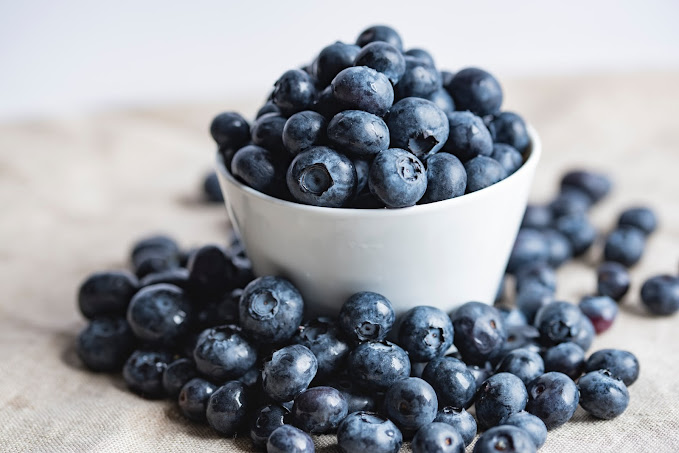
Photo by Joanna Kosinska on Unsplash
Blueberries are a very popular part of North American diet. One simple reason is because it tastes good. But are you aware of its nutritional facts and what the latest research indicate about this "super fruit"?
In this article:
Blueberries benefits in brain health, diabetes and cardiovascular health
Latest trends in snacking
Blueberries nutrition facts
Ways to incorporate blueberries into daily diet
Blueberries Benefits in Brain Health:
- Krikorian et al. 2020: Older subjects who were showing signs of memory impairment were enrolled in a study for 16 weeks where they consumed one serving of blueberries daily (1 cup). At the end of 16 weeks, significant improvement was noted in visual and spatial memory with increased memory processing speed.
- Miller et al. 2017: 13 healthy men and 24 healthy women between the ages of 60 and 75 were randomly selected to either receive daily supplementation of blueberries or a placebo for next 3 months. The group that received blueberry supplementation showed significant decline in making errors in their verbal memory.
Blueberries Benefits in Diabetes:
- Stull et al. 2010: The experimental group that received daily supplementation of blueberries for 6 weeks displayed significant improvement in insulin sensitivity.
- Stote et al. 2020: Consumption of blueberries for 8 weeks resulted in significant reduction in type 2 diabetes risk factors and improvement in HbA1c levels in overweight men.
Blueberries Benefits in Cardiovascular Health:
- Johnson et al. 2015: Blueberries consumption for 8 weeks lead to a 5-6% decrease in high blood pressure in post-menopausal women.
- Curtis et al. 2019: One cup of blueberries intake daily for 6 weeks resulted in significant improvements in heart health measures in men and women with metabolic syndrome.
Latest Trends in Snacking:
According to a survey conducted by Information Resources Inc. & US Department of HHS, almost half of Americans consume 3+ snacks per day and one-third consume 4+ snacks per day, out of which 65-75% Americans want snack items that curb hunger, boost energy and provide nutrition. Snacking with nuts and fruits can help boost nutrition and provide additional health benefits as they increase the overall diet quality and provide essential nutrients to children.
Blueberries Nutrition and Benefits: Powerful Snacking Option
A handful of blueberries is roughly equal to a cup or one serving, which is equivalent to 80 calories. Four major nutrients that are packed in blueberries include: fiber (increases fullness, aids in digestion and regulates healthy cholesterol levels; 3.6g per serving), vitamin C (a strong antioxidant that improves immunity, stabilizes free radicals and prevents cellular damage, helps in collagen synthesis to support healing, increases iron absorption; 16% of daily requirement per serving), vitamin K (regulates blood clotting and metabolism; ~25% of daily requirement per serving), Manganese (aids in bone development and converts digested food into usable energy; ~25% of daily requirement per serving).
How to Incorporate Blueberries in Your Diet:
- Blueberries provide complex carbohydrates in form of high dietary fiber. They are best paired with forms of proteins such as nuts, seeds, cheese, hummus, yogurt and eggs.
- The sweetness of blueberries can be paired with savory items including various herbs, lemon, cheese, olives etc.
- Bowls (with proteins, greens, fats and carbs) and smoothies (with greens and fruits)
- Bento boxes: kids-friendly, well-balanced, varied nutrients in one meal.
Blueberries are one of those super fruits that are not only extremely satisfying to our taste but are equally nutritious as well. They can be easily incorporated into our diets in form of sustainable snack items. And, thanks to the versatility in their taste, they can deliciously be paired with savory items, and high-protein foods for a more nutritional balance.
References:
1.Prior RL, Cao G, Martin A, et al. Antioxidant capacity as influenced by total phenolic and anthocyanin content, maturity, and variety of Vaccinium species. J Agric Food Chem. 1998;46(7):2686-2693.
2.Joseph JA,Shukitt-Hale B, Denisova NA,et al. Reversals of age-related declines in neuronal signal transduction, cognitive, and motor behavioral deficits with blueberry, spinach, or strawberry dietary supplementation. J Neurosci. 1999;19(18):8114-8121.
3.Krikorian R, Kalt W, McDonald JE, Shidler MD, Summer SS, Stein AL. Cognitive performance inrelation to urinary anthocyanins and their flavonoid-based products following blueberry supplementation in older adults at risk for dementia.J Funct Foods. 2020;64:103667.
4.Miller MG, Hamilton DA, Joseph JA, Shukitt-Hale B. Dietary blueberry improves cognition among older adults in a randomized, double-blind, placebo-controlled trial.EurJ Nutr. 2017;57(3):1169-1180.
5.Stull AJ, Cash KC, Johnson WD, Champagne CM, Cefalu WT.Bioactivesin blueberries improve insulinsensitivity in obese, insulin-resistantmen and women.JNutr.2010;140(10):1764-1768.
6.Stote KS, Wilson MM, Hallenbeck D, et al. Effect of blueberry consumption on cardiometabolic health parameters in men with type 2 diabetes: an 8-week, double-blind, randomized, placebo-controlled trial. CurrDev Nutr. 2020;4(4):nzaa030.
7.Johnson SA, Figueroa A, Navaei N, et al. Daily blueberry consumption improves blood pressure and arterial stiffness inpostmenopausal women with pre-and stage 1-hypertension:arandomized, double-blind, placebo-controlled clinical trial.JAcadNutrDiet. 2015;115(3):369-377.
8.Curtis PJ,van der Velpen V, Berends L,et al. Blueberries improve biomarkers of cardiometabolic function in participants with metabolic syndrome —results from a 6-month, double-blind, randomized controlled trial.Am J Clin Nutr. 2019;109(6):1535-1545.
9.IRI.How America eats:the state of the snacking industry. https://www.iriworldwide.com/IRI/media/Library/webinar/IRI-How-America-Eats_2019-State-of-Snack-Industry.pdf. Published April 9, 2019.
10.US Department of Health and Human Services;US Department of Agriculture. 2015–2020Dietary Guidelines for Americans,8th Edition.https://health.gov/our-work/food-nutrition/2015-2020-dietary-guidelines/guidelines/. Published January 7, 2016.
11.Loth KA, Tate A, Trofholz A, Fisher JO, Neumark-Sztainer D, Berge JM.The contribution of snacking to overall diet Intake among an ethnically and racially diverse population of boys and girls. J Acad Nutr Diet. 2020;120(2):270-279.
12.Barnes TL, French SA, Harnack LJ, Mitchell NR, Wolfson J. Snacking behaviors, diet quality, and body mass index in a community sample of working adults. J Acad Nutr Diet. 2015;115(7):1117-1123.
13.U.S. Highbush Blueberry Council. 2019 U.S. Highbush BlueberryCouncil segmentation study.
14.Moghaddam E, Vogt JA, Wolever TMS. The effects of fat and protein on glycemic responses in nondiabetic humans vary with waist circumference, fasting plasma insulin, and dietary fiber intake. J Nutr. 2006;136(10):2506-2511.
15.Flavor pairings. U.S. Highbush Blueberry Council website. https://www.blueberrycouncil.org/blueberry-cooking-tips/flavor-pairings/.


